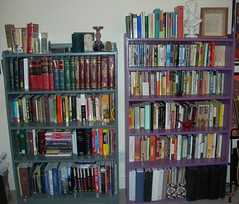
Monday, June 2, 2008

Gang Leader for a Day

by Sudhir Venkatesh, 2008
302pp
01/27/08-02/02/08


Careful readers of this blog will note a one month gap in the reading dates between this book and the book previous. Of course, I wrote that last blog post, oh, about 3 months ago. I can't really account for either lacuna. I remember there being a time where other, less demanding forms of narrative dominated my attention. I believe "The Wire" was on the air at the time. This of course can only partially account for my apparent sabbatical from reading, just as the stresses of work & turtle-ownership, and the intimidation inspired by a growing pile of unblogged, read books can only partly explain my three month silence on teh blogz.

So I guess I'm saying that the next few entries will be rough sketches of Book Reports. The books are already fading in my memory. The witty comments that occurred to me while reading are long gone.

I want to say I picked up this book the week it came out, and grew steadily more irked as its hype expanded across my personal NPR/NYT/elitist bubble. One would rather avoid the conclusion that one buys the same books as one's insufferable peers. I suppose I got what I deserved; this book was essentially spun out of the talked-to-death Freakonomics.

So you're likely familiar with the schtick: "A rogue sociologist takes to the streets," as the dust jacket says. Venkatesh, as a PhD student, ingratiates himself into the world of Chicago's notorious Robert Taylor housing projects. Apparently he studied "the underground economy," and it might be interesting to see some of his more academic writing on that subject. This book, however, is mostly an exercise in shock & voyeurism. Which is not especially groundbreaking; there's a reason we call it "slumming." Still though, the book packs quite a vicarious thrill, and it's fascinating to see the many ways the gangs functioned as quasi-community organizations. It can be eye-opening in the same way as "The Wire."


Venkatesh has apparently managed to parlay his degree (& Richard Roundtree's jacket) into a brisk gig as an authority on the Street. So far, he's been tapped to weigh in on such "hood" topics as The Wire, Grand Theft Auto, Spitzer's call girl, and Barack Obama.

Saturday, March 8, 2008

At Swim-Two-Birds

by Flann O'Brien, 1951
239pp
12/22/07-12/31/07


For those of you keeping score, this is the third Flann O'Brien book I read in 2007. I never set out to do so. I don't pretend to 100% understand this phenomenon, which is fitting, because I don't pretend to 100% understand O'Brien.

I have this peculiar love of frame stories & metafiction. I can't justify it--really, I half-want to dismiss the stuff as gimmick & wankery--but it somehow thrills me to read a real head-trip of a book. Of course this was just such a book, one that might be easier to summarize with diagrams than with words. The outer frame follows an Irish student, more inclined toward drink & sleep than studies, who writes a book. In that book, a moralizing old man writes a book that draws on a variety of styles & characters: Celtic myth, medieval poem, and the improbable cowpunchers of Dublin. This "inner" author forces his characters to live with him, under his roof, until they conspire to hijack the narrative against him. Disparate literary styles are mimicked & mashed-up to comic effect, and with virtuoso skill.

For years the frequent mention of Joyce when discussing O'Brien mystified me. Over the past year this has made more & more sense.

A little after I read the book, this piece was posted on Slate, for some reason. It was really pleasing to read: I love to picture Nathaniel Rich saying "Y'know what? Flann O'Brien could fucking write," to which a cigar-chomping, green-visored editor must've replied, "Print it, my boy!" I of course anticipated Rich's comparison between O'Brien & Sterne, but it probably was never that original a sentiment to begin with.


This was also the third book from Dalkey Archive Press (Normal, IL) that I read in 2007. Whatever it says about me that I read three O'Brien books in '07, reading three Dalkey Archive books (The Dalkey Archive being one of them) probably says roughly the same thing.

"The Dalek Archive" popped into my head just now, which idea tickles the hell out of me. If you are similarly amused, you can rest assured that you're alright in my book.

Tuesday, March 4, 2008

amulet

by Roberto Bolaño, 1999
184pp
12/14/07-12/22/07


I'd probably never regret the act of reading, were it not for the certainty that there are so damned many good books out there I'd like to read. Every week the New York Times, Fresh Air, and the front table at Borders bring ten or twenty noteworthy new books to my attention; of these, a good three or four sound worth reading, at least until I forget about them, or they're revealed as massive hoaxes. So when I try out a book and don't like it, I'm keenly aware of the book I could've been reading.

I was taken in by some year-end hype when I picked up this book. Bolaño's The Savage Detectives appeared on NYT's "Top 10 Novels of 2007" list. That book was made to sound interesting, but its length made it a dodgy proposition. I decided to sample some of Bolaño's shorter writing.

Also of some relevance when I picked up this book: I've particularly enjoyed a few Hispanic/Latin American creators the past year or so: the Hernandez brothers, Alejandro Jodorowsky, Salvador Plascencia, even Gabriel Garcia Marquez, to a certain extent. I figured I was on some kind of kick, and thought I'd follow through with "[h]is generation's premier Latin-American writer."

To be sure, maybe I would've appreciated this book if I actually knew a thing or two about Latin American writers of any generation. This is the first-person account of the toothless, Uruguayan "Mother of Mexican Poetry." Though she writes no poetry herself, she cavorts with the artists and Bohemians of Mexico City in the late 60s. Kind of like A Moveable Feast, only the Mexican version. Despite my recent interest, I am entirely ignorant of Mexican writers (or Latin American, for that matter), so I'm unclear as to whether the writers & artists the narrator spends her time with are fictitious, or actual pillars of a genuine Mexican literary scene. I could quickly consult Wikipedia to clear this up, but am for some reason disinclined.

Further proof of my ignorance: this book largely centers around the apparently notorious political unrest of Mexico City, 1968. Eurocentric that I am, I was rather more familiar with Paris's troubles of that year. Apparently the University of Mexico was invaded by the Army, and it seems that this event was seared into the consciousness of the Mexican people. What next, Mexican Situationists?


So, I'm thinking an art director designed a really good dust jacket for this book, but on her way down the hall to her boss's office, she bumped into an art director who happened to be working on some homoerotic bodice-ripper, papers flew from the portfolio of the one art director into the portfolio of the other art director, and amulet ended up with this gay-ass cover.

Tuesday, February 19, 2008

Pnin

by Vladimir Nabokov
191pp
11/24/07-12/14/07


This is as good a place as any for an apology. I've gotten way behind in my blogging. I apologize to the internet, and to the housing market, for good measure.

Thus I really can't remember why exactly I picked up this book almost couple of months ago. I seem to recall there being some mention of Nabokov. And then he came up again in that godawful "Sex Children" piece in Best American Essays. So I guess I felt like finally getting around to reading Nabokov, if not at the most obvious starting point. My selection probably had something to do with its mention in this cute piece in Slate.

Is "academic satire" a genre? I suppose this is a sort of "campus novel", one that, like Lucky Jim, is more concerned with professors than coeds. Professor Timofey Pnin is a sweetly foreign professor at a small Eastern college a decade before campus unrest; a time when academia was an elbow-patched, cocktail-swilling, boys' club. Pnin seems socially inept, but it's more fair to say he's doubly out of place, in America & in its rarefied university atmosphere. Pnin's frequent confusion and mangled English are played for comic effect, or at least the kind of comic effect that ran in The New Yorker in the Fifties. That's really about all I remember about the book.

One memory of the act of reading it stands out, however: I had to wait several minutes on a cold MARTA platform, entertaining a three year-old until the train arrived. I'd not been prepared for this, and had only this paperback in my pocket. Anyhow, I must have kept her attention for twenty minutes with this book. The book's action couldn't have interested her--something about renting an apartment in a university town--but the words kept her attention, which struck me as a serious testament to Nabokov's craft. A creative writing workshop could probably do worse than require students to read their pieces to three year-olds.


This cover initially struck me as terribly bland & unimaginative, but while reading the book I realized the photo's practically a literal illustration, and may well have been staged for just this purpose. The image of a man and a squirrel on a path comes up two or three times, and I don't know that I would have noticed if not for the cover.

Tuesday, January 8, 2008

Four Trials

by John Edwards, 2004
236pp
Read 11/20 - 12/10


For his unconventional 2004 campaign book, John Edwards chose to write an experimental sequel to Kafka' The Trial, making him the first candidate since Nixon (Six Crises, The Public Burning) to win the support of both postmodernist and expressionist voting blocks.

Sigh. In my world, Edwards secured the '04 nomination, and went on to win the presidency.

This in no ways constitutes an endorsement on the part of this humble blog, but I really think a lot of people--people well outside his current base--would warm up to Edwards after reading this book. (It could similarly affect attitudes toward plaintiffs' attorneys). Which, yes, is the point of campaign lit. And no, I've never read a single other presidential campaign book. I pretty willfully avoid them, and as such I presume to know a thing or two about them. Thus I can tell you that this is not a typical campaign book. It doesn't set forth any bold visions for America, nor does it primarily concern itself with relating Edwards' biography. Granted, it's impossible to read this book without coming away with a sense of Edwards' thoughts on personal & social justice, and you ought to be able to pass a quiz on his background and family. But the book cleverly embeds the electioneering inside a collection of compelling courtroom dramas. The real-life story arcs here are amazing, as is Edwards' finesse. Having taken trial practice classes in a North Carolina law school, I'd pretty well had it drilled into my head that Edwards is technically brilliant, but the book gives the reader some idea how superhumanly dedicated and hardworking that kind of lawyer has to be.

There is a single point, though, where Edwards' credibility falters: waiting on a jury verdict, he advises his client to reject a large settlement offer because it was less than his client "deserved." Bullshit. Edwards is a calculating professional, and he rejected the offer based solely on the probability of a higher award from the jury. Haughtily snubbing the offer out of abstract concerns for what his client "deserved" was never an option.


Borrowed book! I borrowed a book! Terrible human being that I am, I read this despite having at least two other borrowed books in the queue whose indulgent owners are probably running out of patience.

Monday, December 3, 2007

The Best American Essays: 2007

Edited by David Foster Wallace
307pp
Read 11/22 - 11/24


If you haven't figured out that the guy blogging about his favorite books is an elitist douche, consider this: over the Thanksgiving break, while so much of America (including my own family) spends a couple days straight eating leftovers and watching nonstop football, I had pretty much the equivalent binge with this collection of contemporary essays.

Which actually made for a nice holiday. I doubt I'd've enjoyed reading a novel of comparable length over the same time; at some point boredom, familiarity, and L-tryptophan would have gotten the better of me. I don't often read any kind of anthology, but I really enjoyed this little prose Whitman's Sampler.

Not to say that it was uniformly great. I'll freely admit to skimming the latter half of one of the Iraq pieces, and the insufferable exploration of teen sex appeal. As if that's even a topic. If anything, I'd maybe sacrifice some of the collection's dazzling diversity (while acknowledging that a diverse offering is a strength in this kind of collection) in favor of a greater emphasis on "craft."

Maybe this opinion is a vestige of AP English, or the "Art of Prose" course I once took, but, aside from poetry, nowhere is the painstaking effort and deliberation of the writer made more apparent than in a well-written essay. Here, the piece about Cesar, "the dog whisperer," serves as a good example. In 15 pages, Malcom Gladwell's keen eye reduces Cesar's "presence" to its constituent gestures, he renders them in lucid prose, and then extrapolates a couple of lessons in nonverbal communication and animal psychology. In the hands of the essayist, the stuff of everyday life is plainly, nakedly exposed in such a way that we see what we'd never noticed, and the universe is revealed in the quotidian. (In one of the above-mentioned courses, I remember reading Annie Dillard's piece about coming across a frog beset by a giant water bug, watching it ruck, rumple and fall. And somewhere between that description, those lilting verbs, and the exercise of labeling paragraphs descriptive, informative, or speculative, I had a blinding revelation.)

But affecting as it is, I sadly don't often read that kind of writing today. I've never really considered why, but I'm inclined to blame my cynicism. So I'd secretly hoped that this book would provide an occasion for that sort of reading. And it sometimes was. Everything I read was good, but only a couple of writers really put me in awe of their talent. And I'm convinced there could've been more of that kind of writing. In his introduction, DFW says something about how our nation's complicity in the reelection of GWB means that he left out "descriptive pieces on ferns" in favor of screeds about how America flaunts the rules of war. Which--speaking as someone who lets liberal guilt dictate a shameful number of daily decisions--I could give a shit about political whinging when considering good writing.


I've pretty much never seen David Foster Wallace's name on something and not bought it. Not that his introduction here is spectacular: the obligatory footnotes, a stale stab at political humor (an extended "decider" joke? really?), and some unimaginative wordplay (one can almost picture the scene, a high schooler in French II: "So 'essay' means 'to try?' I'm totally gonna use that in my next English composition!").

Monday, November 12, 2007

Incompleteness: The Proof and Paradox of Kurt Gödel

by Rebecca Goldstein, 2005
296pp
10/18/07 - 11/11/07


When I was an undergrad, I read a lot more science than I do now: popular science writing, science biographies, and philosophy of science. This, in hindsight, is one of the few ways I'll acknowledge that going to an engineering school actually molded me. Not that my own studies had anything to do with any real engineering, science or math, but my friends mostly came from the computer science and physics schools. I don't know that I was aware of it at the time, but the people I surrounded myself with shared a peculiar set of reading habits. Very few people read literature--probably a good many would have told you that fiction doesn't matter--and everyone else seemed to pick their books from this limited pool of science books. James Gleick's Chaos was ubiquitous (I still remember the student bookstore's huge yellow piles of his FSTR, when that book came out), and so many people were reading the 25th anniversary edition of Gödel, Escher, Bach, that I'd assumed it had been assigned for some freshman lit class. And so for a couple of years there I let my peers' reading habits rub off on me. I suppose that if I'd been at a liberal arts college, I'd've been reading Dante, or whatever one reads to look deep and impress girls (which might be a nutshell summation of my understanding of a liberal arts education). Obviously, my current reading preferences have turned toward literature, and postmodern fiction in particular, but I probably have more of a taste for science writing than I would've had I not gone to Georgia Tech.

My choice of this particular book was prompted by two things: I'm currently in the middle of an audiobook version of American Prometheus: The Triumph and Tragedy of J. Robert Oppenheimer (incidentally I don't blog about audiobooks. Nor comic books or law books), and I came across this interview with R. Goldstein.

Despite having gotten about a third to halfway through the aforementioned GEB--the usual length for that book--I could not have told you a damned thing about the Incompleteness Theorems of Kurt Gödel, aside from how to pronounce his name. Maybe. Having read this book, I'm in a somewhat better position. Six months from now I will have forgotten entirely.

To be sure, this is 99% my own fault. This kind of explicatory writing about abstruse subjects cannot be read casually, or in short bursts. Often I would pick up the book, and spend ten or fifteen minutes refreshing myself as to, say, the technical meaning of "consistency" or Euclid's fifth postulate. Had I really dedicated myself to seriously reading Goldstein's explanation of incompleteness, I would not have so often lost her train of thought.

Having spoken in defense of Goldstein's writing, I can now proceed to offer criticism, hoping that Steven Pinker will not come to my apartment to beat me up.

Right in the heart of the densest, most difficult part of the book, when Goldstein's explaining the First Incompleteness Theorem, the reader--which reader obviously came to the table hoping to wrap his head around this central piece of 20th Cent mathematics--is asked to take a pretty huge leap of faith. After performing the admirable task of making Gödel numbering clear, Goldstein tells us that Pr(x), the property of "provability", is "a formally expressibly arithmetical property, albeit one that is extremely complicated, not anything that we can explicitly give here." Really? Not even, like, a little bit? I get that this is way too much math for my little head, I really do, but a sentence like that, stuck in this kind of book, bears a whiff of prestidigitation. Goldstein is in the process of blowing my mind by telling me (I think), that so abstract a property as the provability of a proposition, given the arbitrary system of Gödel numbers, can be expressed as a function, when she then tells me I'll just have to trust her (& 20th Cent mathematics) on that one. Which, I mean, I do. But I'd really appreciate it if as great and lucid writer as Goldstein at least made an attempt at my halfway understanding that particular point.

There's a lot more to this book than just Goldstein's accessible explanation of that remote area of math, even though that's the part (pp 150-188) that readers might be most interested in. It starts with a good bit of intellectual history, describing the Wiener Kreis to set the stage for a discussion of the philosophical implications of the Incompleteness Theorems. There's a really charming part at the end, where Goldstein describes her time as a grad student at Princeton, fascinated by the luminary in her own backyard. She then briefly and respectfully moves on to Gödel's paranoid demise; unfortunately the man was so withdrawn that I doubt anyone will ever be able to credibly write at length about the no-doubt fascinating world of his inner delusions.


This book comes to us from the "Great Discoveries" imprint, a hit-or-miss series of "Great Thinkers Thinking about Great Thinkers" books. I'm a big fan of DFW's Everything & More from this line, and Incompleteness could almost be read as the sequel to that book, or the next book in modern mathematics syllabus.

Strangely, between this book and American Prometheus I am accidentally getting a history of the Institute for Advanced Studies.